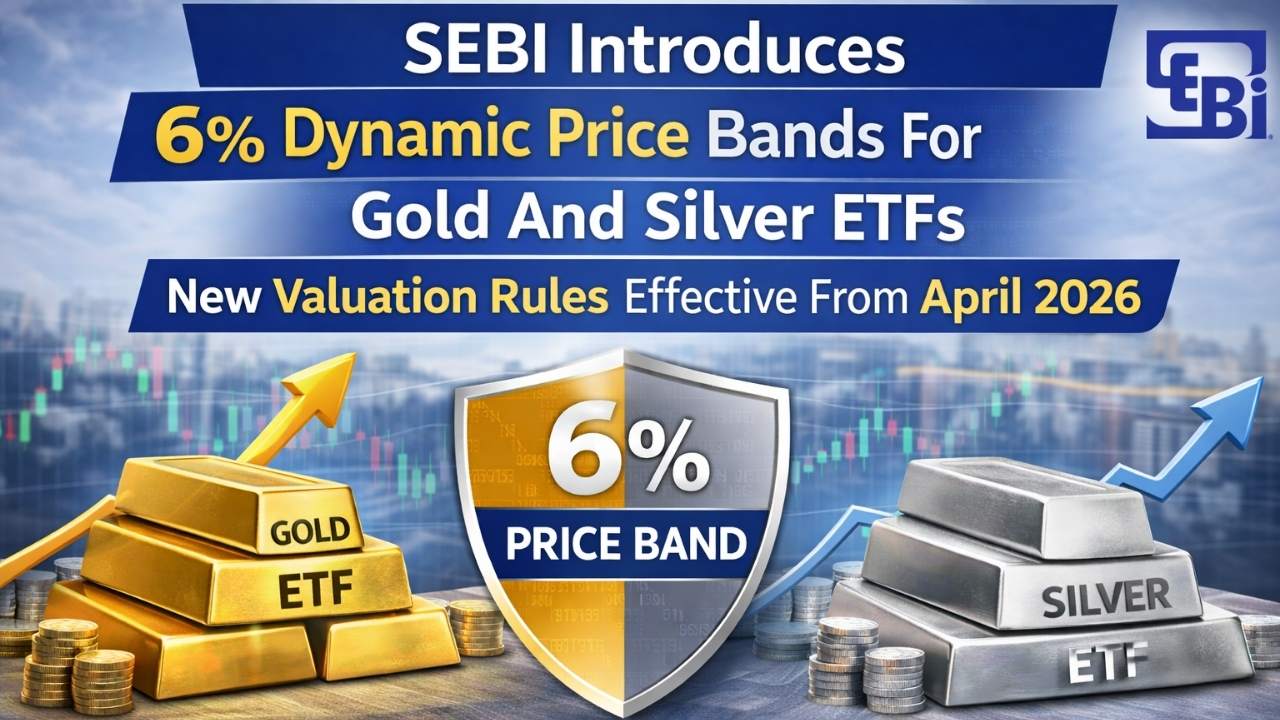
SEBI Gold Silver ETF Rules: India’s precious metal investment market is evolving rapidly, and regulatory changes are playing a major role in improving transparency and investor protection. The Securities and Exchange Board of India has introduced new rules aimed at improving how Gold and Silver ETFs are valued and traded in the market.
These changes focus on aligning ETF prices more closely with real market conditions while reducing volatility caused by sudden global price movements. The updated framework also improves price discovery, reduces valuation delays, and strengthens investor confidence in exchange-traded funds linked to precious metals.
SEBI Introduces New Framework for Gold and Silver ETF Valuation
The Securities and Exchange Board of India has introduced significant reforms to improve how Gold and Silver ETFs are valued in the Indian financial market. These reforms aim to make ETF prices more transparent and closely aligned with the actual value of the underlying metals.
The changes also seek to reduce pricing distortions that may occur due to outdated benchmarks or delays in valuation. By implementing a more responsive pricing structure, SEBI aims to ensure that investors receive a fair and accurate representation of the value of their ETF investments.

Major Changes Announced by SEBI for Precious Metal ETFs
One of the major reforms involves revising the valuation method used for the physical gold and silver held by ETFs. Earlier, many funds relied heavily on international benchmarks such as London bullion prices to determine asset values.
Under the new rules, ETFs will increasingly rely on domestic spot prices from recognized Indian exchanges. This change is designed to reflect the local market conditions more accurately and reduce dependence on global reference prices.
SEBI Gold Silver ETF Rules Overview
| Key Aspect | Details |
| Regulator | Securities and Exchange Board of India (SEBI) |
| Affected Investments | Gold ETFs and Silver ETFs |
| New Valuation Method | Domestic spot prices from recognized exchanges |
| Previous Benchmark | International LBMA benchmark prices |
| New Trading Band | ±6% initial price band |
| Maximum Price Band | Up to ±20% during the trading day |
| Cooling-Off Period | 15 minutes when limits are hit |
| NAV Adjustment | Shift from T-2 NAV to T-1 NAV |
| Implementation Timeline | Expected from April 2026 |
| Key Objective | Improve price accuracy and reduce volatility |
Shift Toward Domestic Spot Price Benchmarking
The updated framework replaces the earlier reliance on international benchmarks with domestic spot prices for valuation. This shift ensures that ETF prices better reflect the real conditions of India’s gold and silver markets.

Using local spot prices also improves transparency and reduces discrepancies between ETF valuations and the prices seen by investors in Indian markets. This step strengthens confidence among investors who track domestic price movements.
Dynamic Price Band System to Control Volatility
SEBI has introduced a dynamic price band mechanism for trading Gold and Silver ETFs. Initially, these ETFs will operate within a trading band of plus or minus six percent from their base price.
If the price reaches this limit during the trading session, the band may gradually expand after a pause. The maximum allowable movement during a single trading day can reach up to twenty percent, helping balance market flexibility and investor protection.

Cooling-Off Mechanism to Stabilize ETF Trading
When ETF prices hit the initial trading limit, a cooling-off period will be triggered to control excessive volatility. This pause allows market participants to reassess price movements and prevent sudden speculative activity.
The cooling-off duration is set at fifteen minutes. After the pause, trading resumes with a wider price band, allowing markets to adjust gradually without creating extreme price distortions.
Faster NAV Calculation to Reduce Pricing Delays
Another key change involves the base price used for ETF trading. Earlier, the base price relied on the net asset value calculated two days prior, which sometimes caused delays in reflecting current market conditions.

The revised system proposes the use of the previous day’s net asset value instead. This shift from T-2 NAV to T-1 NAV helps ETF prices move closer to real-time metal price changes.
Possible Introduction of Pre-Open Trading for ETFs
SEBI is also considering introducing a pre-open trading session for ETFs linked to precious metals. This proposal aims to help ETF prices adjust before the regular trading session begins.
Global gold and silver markets operate almost continuously, while Indian exchanges have fixed trading hours. A pre-open session could help align ETF prices more closely with overnight global price movements.

Why SEBI Decided to Reform Precious Metal ETF Rules
The regulator observed that ETF prices sometimes deviated from the actual value of the underlying metals during periods of high volatility. Such differences can create confusion for investors and distort the market.
By updating valuation methods and trading mechanisms, SEBI aims to minimize such deviations. The reforms ensure that ETF prices remain closely linked to real market values.
How the New ETF Rules May Impact Investors
For investors, the new framework is expected to bring greater pricing accuracy and improved transparency in precious metal ETFs. Investors may see ETF prices that better reflect actual gold and silver market values.
However, temporary trading pauses could occur when price bands are triggered during volatile sessions. Despite this, the overall structure aims to create a safer and more stable investment environment for ETF investors.